


2005 When the kid stumbled through the oaks onto his…
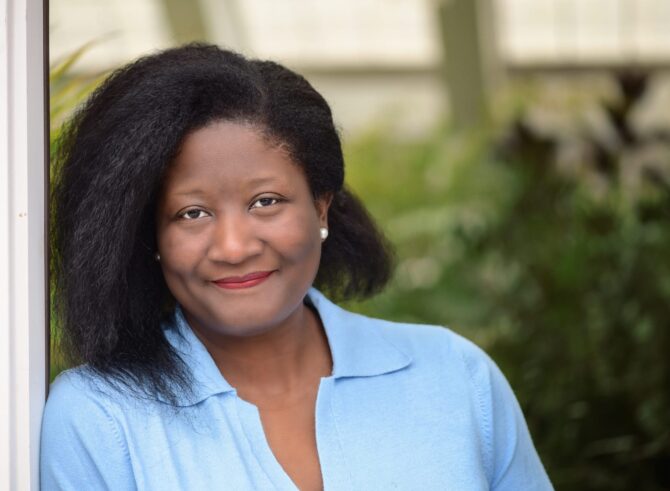
Monic Ductan on ‘Daughters of Muscadine’, Black Appalachians and the writers who have inspired her
Monic Ductan was born and raised in north Georgia, so it’s only natural that her debut short story collection, Daughters of Muscadine, is set in that oft-overlooked part of rural Appalachia. A fictional town with a complex history, her Muscadine is home to several generations of Black, working-class, mountain families whose women have faced discrimination, violence, estrangement and erasure. In muscular prose and with startling insight, she records their inner lives as they navigate situations both large and quotidian.
Ductan, a professor of literature and creative writing at Tennessee Tech University in Cookeville, Tennessee, makes clear in these stories that the past remains alive and is still deeply felt. The collection opener, “Black Water,” centers on a haunting. The ghost is Ida Pearl Crawley, a Black woman who was lynched in the 1920s for purportedly setting fire to the home of her employer Herbert Munson, a white man who is also the father of her two children, which kills him and his family. Three generations later, “talk of Pearl is still plentiful as the mosquitoes that swirl around Harmony Shoals.” The Crawley and Munson families keep a distance from one another, and yet it seems each knows the truth of their relations.
Other legends and legacies populate these pages, including a member of the local girls’ basketball team, a girl in the 1950s who sees her loneliness reflected in the pages of Anne Frank’s diary, and a mother who comes face-to-face with the daughter she gave up for adoption.
Ductan, a contributor to Appalachian Review and other magazines including Oxford American, Shenandoah, Southeast Review, Good River Review and more, recently chatted with editor Jason Kyle Howard about Daughters of Muscadine, representation of Black Appalachians and the writers who have inspired her.
■■■
JASON KYLE HOWARD: You have been published all over the place, from Oxford American and Shenandoah to Kweli and here in Appalachian Review, but Daughters of Muscadine is your first book. How are you feeling now that it is out in the world?
MONIC DUCTAN: I’m elated. This is a group of stories I began writing as a graduate student when I was living down in Georgia, and I continued working on the project after I became an assistant professor [at Tennessee Technological University]. I was lucky enough to get a wonderful publisher, UPK [University Press of Kentucky], and I worked with great editors and a talented cover artist. I’m overall proud of the work.
JKH: You have created a fictional town in Georgia where most of these stories are set and to which all are connected. Can you talk a bit about the challenges and joys of making a collection of stories linked through a place?
MD: This collection was a joy to write because it made me reflect on my home. At times, it made me nostalgic. I was born and raised in Georgia, and my family has lived there for at least 200 years, so I’m deeply rooted in that place. I had some images in my head of places in north Georgia as I was writing. For instance, the shoals I mention in the book are based on Hurricane Shoals, near my hometown. One challenge I had is that I’m writing about the South, a place where people who look like me have been disadvantaged for so long. I obviously can’t write the whole thing with nostalgia because I’m writing about some deeply disturbing things like lynching, racial prejudice, and family loss. It’s hard to find the right balance between nostalgia and truth.
JKH: The stories take place over a hundred years, from the 1920s to the present. You do a beautiful job of placing us subtly in each time period. How do you go about doing that?
MD: I enjoyed writing about the various time periods in the book. For instance, “June’s Menorah” is set in 1959, so I tried to throw in some subtle references, such as the type of car they drove and the fashion of that time period. I admire vintage fashions, and I love Peter Pan collars and those A-line skirts from mid-twentieth century America. I wrote each story separately and then thought about how I could link them together. The name Crawley comes up often, and that was purposeful. I wanted to depict life in a small town where you hear some of the same surnames over and over again for generations.
JKH: You focus a great deal on the complexities of our most intimate relationships—between siblings, between parents and children, between lovers. Why are you attracted to telling these stories?
MD: I’ve always been inspired by the stories I enjoy reading and the media I consume. Some of my favorite stories are about family relationships and friendships. I also love strong women characters. I grew up watching Fried Green Tomatoes and Norma Rae. I also love reading books about complicated family relationships, such as Bastard Out of Carolina, which is probably my favorite novel.
JKH: Each of the book’s stories is so well structured and include so many vivid characters and that tremendous sense of place that binds them all together. Who have been your major influences in the short story form?
MD: Where to begin? There are so many good short story writers! Here are a few stories that come to mind, and I’ve listed the authors, though I’m sure I’m forgetting a few stories: “The Third and Final Continent” and “Hell-Heaven” by Jhumpa Lahiri, “A Good Man is Hard to Find” by Flannery O’Connor, “Everyday Use” by Alice Walker, “Going to Meet the Man” by James Baldwin, “Home Visit” by Natalie Sypolt, “Bullet in the Brain” by Tobias Wolff. I’m currently reading Stephanie Powell Watts’s collection, We Are Taking Only What We Need, and I like that book a lot.
JKH: You’re from northern Georgia where these stories are set. How challenging is it to write about home, or your place of origin, with honesty and complexity?
MD: When I was a child, I embraced my town because it was the only place I really felt I knew, and then as a young adult I became more critical. I grew up poor, partly because my mother and father were denied access to a good education in the Jim Crow South. Barriers to education have plagued Appalachia too, of course. Coming to that realization as a young adult turned me bitter. I started to become aware of how others view Southerners, how others view Black people, and how Appalachian people are viewed.
One thing I love about literature and about regionalist literature is its diversity. The way I write about the South and the way I write about Appalachia would look different than how you or another Appalachian writer would do it. My stories are colored by my experiences growing up poor and Black. I grew up in Appalachia, though my Black family would probably never define us as Appalachian. I’ve never heard my mama use the word. She’d probably see it as a government label, and she is often distrustful of government. In fact, she once asked me what “Black English” is, even though she clearly speaks it. She just sees it as “English” because it’s normal to her.
Now, at middle age, I feel the need to embrace all those labels. There’s nothing shameful about growing up poor, Black, Southern, and Appalachian. My writing grapples with this struggle to accept and reject labels. As a Black woman, I’ve often felt I couldn’t be proud to be Southern because of the South’s painful history, but now I’m viewing it differently. My ancestors built the South and the U.S. economy with their hands, and our influences on the Southern dialect and food are undeniable. There’s pride in that.
Dorothy Allison once wrote in an essay that when she was growing up in the 1950s the poor people depicted on TV and in the media were the good poor. They were poor, but they were hard-working, clean, and other adjectives that made them respectable. Her family, Allison points out, wasn’t like that. They were poor and uneducated and dirty and angry. I think overall, she’s saying that her stories also deserve to be told, even though her family were not the respectable poor. I agree with her. I come from a family similar to hers, and I want to tell my family’s stories, even though they may not always be pleasant to read about.
JKH: Although this is thankfully beginning to change, the presence and stories of Black Appalachians have historically been erased or minimized. What do you hope Daughters of Muscadine communicates about the Black Appalachian experience?
MD: One reader reached out to me on social media to say that the book made her homesick for her hometown in the South, and that was a big compliment to me. I hope I’ve depicted this place well enough to do it justice, and by that I mean that I want people to recognize their homeplace when they look at it. I also think representation is important. When I was a child, I read mostly white writers and felt that most of those books weren’t written with me in mind. I wanted Daughters of Muscadine to be a book for women like me, a book in which Black women are at the center and not the margins.
JKH: Besides writing fiction, you do quite a bit of nonfiction. How are the forms different and similar for you?
MD: My nonfiction is usually narrative, so there’s not always a big difference for me. I tend to write a lot about my family in nonfiction. If the story works better by sticking to the truth, then I write an essay. If I want to explore and change the details and see where it takes me, then I write a story. My essays feel a lot more personal than my stories, though. Plus, it’s sometimes difficult to link my experiences together in a cohesive way, which is one big challenge I find in writing personal essays.
JKH: Any chance we’ll see an essay collection in the future?
MD: Yes, I do want to publish an essay collection. I have about five to six essays I’m proud of, and so far they all fit together thematically. Most of them focus on poverty, the South, and race. I have a few essays on the backburner right now while I’m trying to finish a novel manuscript. Once the novel is complete, I’ll go back to the essays. I’ve been trying to write about my mother for a few years now. She was born in poverty in 1939 and had a tough upbringing. I haven’t figured out how to tell her story yet. I’d also like to write an essay about how I grew up in poverty in the South and how that has shaped who I became as an adult. I started a draft of it recently, but I was tackling too much, and the first draft felt scattered because there were so many ideas I wanted to force into it. I think it will become a much longer essay than I originally intended.
JKH: Are there writers in particular who have encouraged you or fostered your work?
MD: I studied writing throughout my time in academia and have been privileged to have some great teachers. Anne Sanow gave me a lot of good advice and saw the earliest drafts of some of the stories in Daughters of Muscadine. In workshop, she once held up a story of mine and said, “This is fine. This is good, but I don’t know if I’ll remember it tomorrow.” It was exactly what I needed to hear about that story. She is a great reader and gives critical advice. I also studied with Alice Friman, a poet who helped me write more concise poems, and she often pointed to something in my work that I had overlooked.
John Holman, Sheri Joseph, Allen Gee, Martin Lammon, Peter Selgin, Laura Newbern, and Steven Barthelme were
the other teachers I studied under. I learned something important from every one of them. For instance, John Holman and Steve Barthelme each had a way of pushing back on student opinions in workshop in a way that made us defend our opinions by pointing to specific parts of the text. This is something I try to emulate when I teach workshops.
JKH: As professors, you and I both work a lot with young writers. What advice might you have for them, and for young writers of color in particular?
MD: This sounds like simple advice, but I often tell my students to write with a purpose. When I first started writing, I knew I wanted to tell stories, but I didn’t stop to think about what types of stories I wanted to tell. Now, after this first collection, I feel I know quite a bit more about what sort of writer I want to be.
I always tell students not to be afraid to tell the story they want to tell. Sometimes they’re worried about what everyone will think of them, or they worry especially about what their classmates will say in workshop. I think sometimes the best writing comes from people who just go for it. Writers like Tennessee Williams, Salman Rushdie, and Toni Morrison knew that not everyone would be receptive to their work, and yet they wrote it anyway. To me, that’s brave.
I always tell my students that you have to be passionate and steadfast to finish writing a book. Otherwise, you’ll find a thousand reasons to not keep going. Most writers I know work day jobs and have families that take priority over everything else, so it’s sometimes hard to stay motivated to write. You have setbacks in the writing, too. For instance, I must’ve written a hundred drafts of that last story in my collection before I was satisfied with it.
I think sometimes writers of color are discouraged when writing about race. In workshop, other writers have said things like, “[Chimamanda Ngozi] Adichie already wrote about hair, so I think you can omit that part of your story.” I once told a professor that I often write about race and the working-class, and he said, “What are you going to do with that?”
He clearly thinks that everything has already been said about race and class, and maybe most of it has been said, but it won’t stop me from writing my version.
I tell students that no one can choose your subject matter for you. Students sometimes get frustrated if I ask questions and don’t understand all the elements of the fantasy story they’ve created. I tell them to ignore whatever advice isn’t helpful, and focus on what is helpful. That’s what I did in workshop. I was taught mostly by white writers who have never been poor or experienced racism, and they sometimes gave bad advice about those things. I ignored that and focused on what was helpful, and I still learned a lot. ■