


Elegy for Ron Houchin: A Cento Perhaps they are connected…
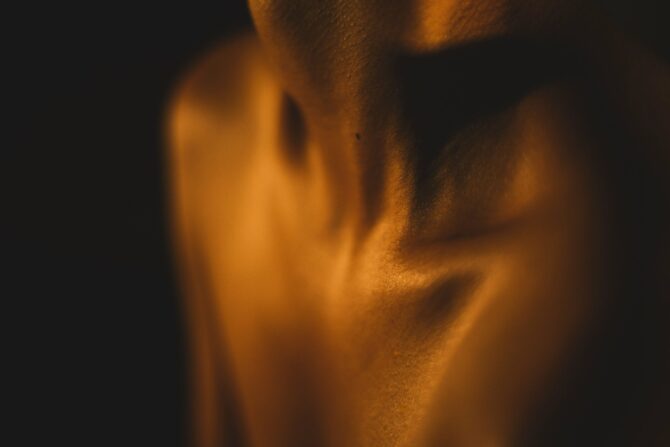
How the Body Writes
We use it to see the white clapboard house where our character grew up, the old blue Corolla his mother drove him to school in, the Chucks he wore with the torn shoelace and the hole at the toe. We see all of this in our heads as if we had lived it, and so we believe that our imagination is a visual parade in our head. But the profundity in experiencing the imagination is in the body.
We imagine with our senses turned up.
We become the child reaching down to fix our shoe. We feel our hunching forward. We smell the rubbery-mildew of the car floor at our feet. We sense the dashboard at the crown of our head, and feel-see our fingers tying the lace that reaches just halfway up our sneaker. After we’re done, the sensation on our right foot is that the shoe, as always, is about to come off, and that sensation of the faulty shoelace reminds us of things we would rather not think about.
That is imagination, an experience translated through the body’s memory.
In his book The Spell of the Sensuous, phenomenologist David Abram says this about imagination:
From the magician’s, or the phenomenologist’s, perspective, that which we call the imagination is from the first an attribute of the senses themselves; imagination is not a separate mental faculty (as we so often assume) but is rather the way the senses themselves have of throwing themselves beyond what is immediately given, in order to make tentative contact with the other sides of things that we do not sense directly, with the hidden or invisible aspects of the sensible.¹
Thus, without our sense of touch, of smell, of sight, of sound, of taste, without our gut reaction, there is nothing to imagine. The mind dreams and therefore seems to transcend the body, but it’s the body that carries the felt experience of transcendence. It’s the body that connects to and reacts to what we experience in our imagination and our dreams. When we’re writing with all of our might and our hearts beat with fear or shame or pleasure, as if we were experiencing that very thing ourselves, it’s our bodies that respond.
■■■
Part of why we disparage the body as a place of wisdom is social, political, and historical. It is analogous to how we!ve been taught to separate people based on race, class, gender, sexuality, religion, and disability. Some people, we are taught, are naturally ignorant, aggressive, unclean, primitive, animal. That’s also how many of us regard the natural world, as a place we think of as separate from ourselves. To broadly paraphrase Abram, we see the natural world as a fascinating, but potentially dangerous place. We keep it at arm’s length, although, ironically, it!s beside us always, in the environment we pass through and in the bodies we inhabit.
I say this not to get wrapped up in something unrelated to writing and creativity, but to show how completely we!ve learned to separate mind from body. As creative writers this separation puts us in a conundrum. We wrestle with the societal preference of mind over body while, as E.V. De Cleyre suggests in “Writing the Body,” we try to (re-)inhabit our old or other selves by writing poetry, fiction and creative nonfiction. We try to (re-)inhabit those selves because the body allows us into the kind of truth the mind cannot get a fix on, for the body cannot lie.²
Good writers write from the body; we listen for what characters want to say; we wait for what is real and true. Good writers default to the mind when the thread of creativity is lost or we face some emotional obstacle that stalls the work. We wait, patiently listening but sometimes fighting against what we hear. We resist ourselves. We force things to be true. Instead, we could listen to our emotional obstacles. We could explore them instead of avoiding or resisting.
Think of listening to emotional obstacles metaphorically, like walking into a pitch black room and shutting the door. The only thing leading us is our intention. We sit in the dark waiting for some indication of what to write next. Something will show up, but it may require assiduous attention, deep listening, commitment to the process. Whatever arises, obstacle or doorway, we acknowledge because there are story roots there. If nothing arises, we wait. Something will show up. When it does, we write it down as best we can. Write and wait, write and wait until the process is complete.
Some of what we get will be relevant to story, some of it will be personal. Record all of it. Instead of looking for a way to avoid the obstacle, we must use it to look for the light. It’s like going toward what scares us. At first we’re terrified, certain we’re going to die, but we don’t. Afterwards everything is easier.
It’s in fear that the gift lies.
Listening to the body requires a patience both deep and long. Patience met with a great deal of latitude when we don’t get the answers we anticipated or when we get no answers at all. Patience is something writers have quite a lot of. No one impatiently writes a 300-page novel, a book of poems, a memoir, a prize-winning short story. This practice of listening to the body, of inspiring truth into the chaos of our lives, would then seem worth the wait. ■
1 David Abram, The Spell of the Sensuous: Perception and Language in a More-Than-Human World. (New York: Vintage Books, 1996), 58.
2 E.V. De Cleyre, “Writing the Body: Ta-Nehisi Coates, Maggie Nelson & Lidia Yuknavitch.” Blog.pshares.org. Network Solutions, LLC, 17 Aug. 2015. Web. 21 May 2015.